
In the relentless pursuit of sustainability, contemporary design has begun to look beyond passive energy systems and embrace a deeper, more holistic integration with the natural world. This paradigm shift finds its most compelling expression in symbiotic architecture, a radical approach that views buildings not as inert structures, but as living, metabolic entities. At the heart of this evolution lies the principle of biotensegrity, a concept borrowed from biology and coined by Dr. Stephen Levin.
Biotensegrity posits that the structural integrity of biological systems—from the molecular cytoskeleton to the human skeleton—is achieved not through rigid compression, but through a dynamic balance of continuous tension and local compression. This synergy, where discontinuous compressive elements (like bones or struts) are suspended within a network of continuous tensile elements (like muscles or cables), allows for maximum strength, resilience, and adaptability with minimum material use.
Applying this ingenious framework to architecture unlocks unprecedented structural efficiency. Traditional buildings rely heavily on gravity-defying compressive stacks, leading to material waste and imposing onerous weight burdens. In contrast, a biotensegrity structure—a neologism often referred to as a "tensegrity structure"—can distribute stresses more uniformly and dynamically. Imagine a future where skyscrapers are not monolithic slabs of concrete but lightweight, latticed ecosystems, inherently responsive to external forces like wind and seismic activity.
This structural revolution is intertwined with symbiosis. A biotensegrity scaffold could accommodate living, photosynthetic facades, enabling the structure to breathe, filter air, and even generate bio-energy. The building becomes a chassis for biological processes, transforming from a static shelter into a proliferating organism. Such a future promises not just lower carbon footprints, but a truly reciprocal relationship between the built and natural environments, offering a tangible path toward genuine ecological stewardship.
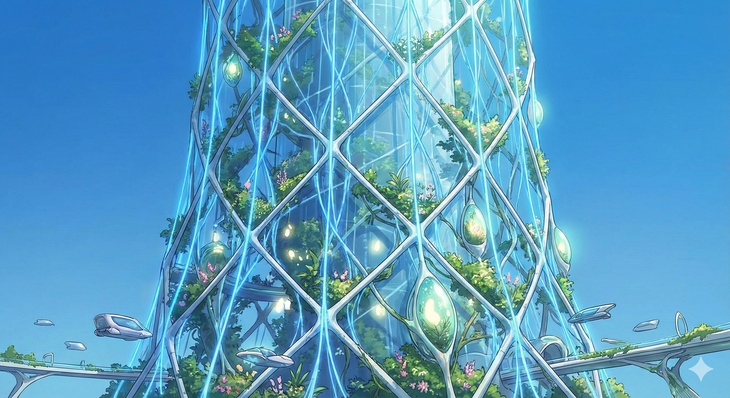
Biotensegrity and the Future of Symbiotic Architecture
中文翻譯
在對永續發展的堅持不懈追求中,當代設計已開始超越被動式能源系統,轉而擁抱與自然界更深層、更全面的融合。這種範式轉移在「共生建築」中找到了最令人信服的體現,這是一種激進的方法,將建築物視為活的、有代謝功能的實體,而非惰性的結構。這場演變的核心在於「生物張拉整體」(biotensegrity)的原則,這是一個源自生物學並由 Stephen Levin 博士創造的概念。生物張拉整體論假定,生物系統的結構完整性——從分子的細胞骨架到人類骨骼——並非透過剛性的受壓來實現,而是透過連續的張力和局部的受壓之間的動態平衡來達成。在這種協同作用下,不連續的受壓元件(如骨頭或支柱)懸浮在連續的受拉元件(如肌肉或纜索)網絡中,從而以最少的材料使用實現最大的強度、韌性和適應性。
將這個巧妙的框架應用於建築學,能釋放出前所未有的結構效率。傳統建築嚴重依賴對抗重力的受壓堆疊,導致材料浪費並造成繁重的重量負擔。相比之下,生物張拉整體結構(常被稱為「張拉整體結構」)可以更均勻且動態地分散應力。想像一下未來,摩天大樓不再是混凝土的巨型板塊,而是輕量化、網格狀的生態系統,本質上能對風和地震活動等外力做出反應。
這場結構革命與共生關係交織在一起。生物張拉整體的支架可以容納有生命的光合作用立面,使結構能夠呼吸、過濾空氣,甚至產生生物能源。建築物變成了生物過程的底盤,從靜態的庇護所轉變為增殖的有機體。這樣的未來不僅承諾降低碳足跡,更預示著人造環境與自然環境之間真正互惠的關係,為真正的生態守護提供了一條切實可行的道路。
🔑 重點單字 (Vocabulary)
- relentless adj.. 持續強烈的;堅持不懈的
- paradigm n.. 範式;典範
- inert adj.. 惰性的;無活動能力的
- integrity n.. (結構的) 完整性;正直
- resilience n.. 韌性;恢復力
- onerous adj.. 繁重的;艱鉅的
- monolithic adj.. 巨型獨石的;龐大而僵化的
- reciprocal adj.. 互惠的;相互的
- stewardship n.. 管理工作;管家職責
掌握一種語言等於擁有一個新世界
 語言健身房 https://www.langym.com 提供
語言健身房 https://www.langym.com 提供
