
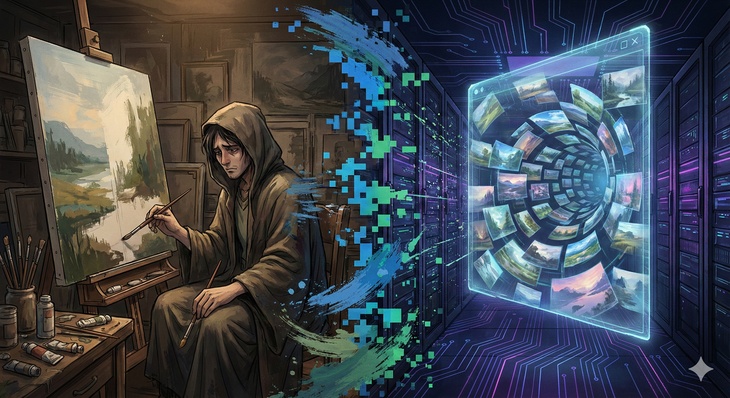
The rapid ascent of generative artificial intelligence (AI) has precipitated a paradigm shift within the creative industries, challenging long-held notions of authorship, originality, and the intrinsic value of human expression. Algorithms capable of synthesizing vast datasets of existing artwork can now produce images, music, and literature that mimic human aesthetic sensibilities with startling accuracy. While proponents argue that these tools democratize creativity by lowering technical barriers, a growing chorus of critics raises profound ethical concerns regarding copyright infringement and the potential erosion of artistic integrity.
At the heart of the controversy lies the mechanism by which these models learn. By scraping billions of images and texts from the internet without explicit consent, AI developers have arguably commodified the collective labor of countless human creators. This practice raises a critical legal and moral question: does the act of training an algorithm on copyrighted material constitute fair use, or is it a sophisticated form of plagiarism? Furthermore, as markets become saturated with AI-generated content, human artists face the existential threat of devaluation, potentially being relegated to mere editors of machine-generated output rather than primary creators.
Beyond the economic implications, there is a philosophical debate concerning the "soul" of art. Critics contend that art is not merely the assembly of aesthetically pleasing patterns but a communicative act rooted in human experience, emotion, and consciousness—qualities that machines inherently lack. An AI may replicate the brushstrokes of Van Gogh or the prose of Hemingway, yet it does so without understanding the anguish or the lived reality that fueled their innovations. Thus, while AI serves as a potent tool for augmentation, the distinction between synthesized mimicry and authentic creation remains a vital boundary that society must navigate carefully.
The Ethical Dilemmas of Artificial Intelligence in Creative Fields
中文翻譯
生成式人工智慧(AI)的迅速崛起,在創意產業中促成了一場典範轉移,挑戰了長期以來關於作者身分、原創性以及人類表達內在價值的觀念。能夠綜合現有藝術作品龐大數據集的演算法,現在可以創作出模仿人類審美感知的圖像、音樂和文學作品,其準確度令人震驚。雖然支持者認為這些工具透過降低技術門檻使創意民主化,但越來越多的批評者對版權侵權和藝術完整性可能受到侵蝕提出了深刻的倫理擔憂。爭議的核心在於這些模型的學習機制。透過在未經明確同意的情況下從互聯網上擷取數十億張圖像和文本,AI 開發者可以說將無數人類創作者的集體勞動轉化為了商品。這種做法引發了一個關鍵的法律和道德問題:使用受版權保護的材料來訓練演算法是否構成「合理使用」,亦或是一種複雜的剽竊形式?此外,隨著市場充斥著 AI 生成的內容,人類藝術家面臨著價值被貶低的生存威脅,可能從主要的創作者淪為僅僅是機器生成產出的編輯者。
除了經濟影響之外,還存在關於藝術「靈魂」的哲學辯論。批評者主張,藝術不僅僅是美學模式的組合,而是植根於人類經驗、情感和意識的溝通行為——這些是機器本質上所缺乏的特質。AI 可以複製梵谷的筆觸或海明威的散文,但它在這樣做時,並不理解激發他們創新的痛苦或生活現實。因此,雖然 AI 可作為一種強大的增強工具,但合成模仿與真實創作之間的區別,仍然是社會必須謹慎應對的重要界線。
🔑 重點單字 (Vocabulary)
- precipitate v.. 促成;加速發生
- paradigm n.. 範式;典範
- intrinsic adj.. 內在的;本質的
- democratize v.. 使大眾化;使民主化
- infringement n.. 侵犯;違反
- commodify v.. 將…商品化
- plagiarism n.. 抄襲;剽竊
- augmentation n.. 增強;擴大
掌握一種語言等於擁有一個新世界
 語言健身房 https://www.langym.com 提供
語言健身房 https://www.langym.com 提供
