The advent of Generative Artificial Intelligence (AI) has sparked a contentious debate within the global art community, challenging our traditional definitions of creativity and authorship. By training on vast datasets of human-made images and texts, AI models can now produce intricate works of art that are often indistinguishable from those created by human hands. This technological leap has left many artists feeling vulnerable, fearing that their unique styles might be appropriated without consent or compensation.
However, many visionaries argue that AI should be viewed not as a replacement for human talent, but as a sophisticated "dual canvas" or a collaborative tool. Just as the invention of the camera revolutionized painting by freeing it from the need for realism, AI can automate repetitive tasks, allowing artists to focus on high-level conceptualization. This symbiotic relationship enables creators to experiment with styles and compositions that were previously too time-consuming or technically demanding to realize. In this sense, AI acts as a catalyst for a new era of hybrid creativity.
Despite the excitement, the ethical and legal ambiguity surrounding AI-generated art remains a significant hurdle. Current copyright laws struggle to address who owns an image prompted by a human but rendered by a machine. Furthermore, there are concerns about the "homogenization" of art, where AI might favor safe, popular aesthetics over avant-garde or subversive expressions. As we navigate this uncharted territory, the art world must establish clear ethical frameworks that protect human creators while embracing the undeniable potential of these new digital brushes.
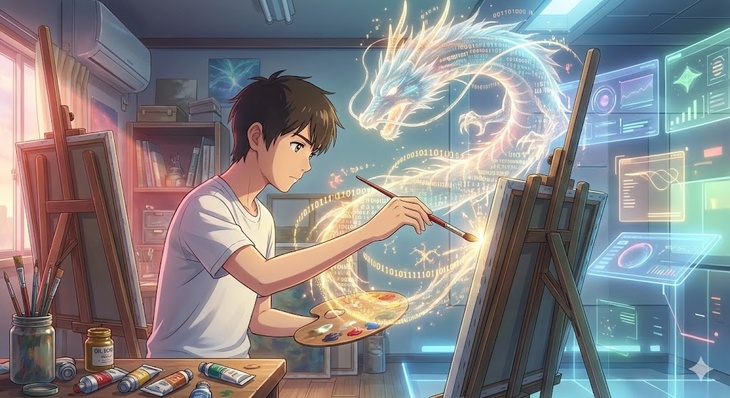
The Dual Canvas: Generative AI and the Future of Artistic Expression
中文翻譯
生成式人工智慧(AI)的出現引發了全球藝術界一場具爭議性的辯論,挑戰了我們對創意和作者身分的傳統定義。透過對大量人類創作的圖像和文本數據集進行訓練,AI 模型現在可以創作出精細的藝術作品,且往往與出自人類之手的作品無二。這一技術飛躍讓許多藝術家感到脆弱,擔心他們的獨特風格可能在未經同意或補償的情況下被挪用。然而,許多遠見卓識者主張,AI 不應被視為人類天賦的替代品,而應被視為一種先進的「雙重畫布」或協作工具。正如相機的發明透過將繪畫從寫實的需求中解放出來而徹底改變了繪畫一樣,AI 可以自動化重複性任務,讓藝術家專注於高層次的構思。這種共生關係使創作者能夠嘗試以前因過於耗時或技術要求過高而無法實現的風格和構圖。從這個意義上說,AI 扮演了開啟混合創意新時代的催化劑。
儘管令人興奮,但圍繞 AI 生成藝術的倫理和法律模稜兩可仍然是一個重大障礙。現行的版權法難以解決由人類下達提示詞但由機器繪製的圖像所有權歸屬問題。此外,人們還擔心藝術的「同質化」,即 AI 可能會偏好安全、流行的審美,而非前衛或顛覆性的表達。當我們探索這片未知領域時,藝術界必須建立明確的倫理框架,在保護人類創作者的同時,擁抱這些新型數位畫筆所展現的無可爭辯的潛力。
🔑 重點單字 (Vocabulary)
- contentious adj.. 有爭議的
- vulnerable adj.. 脆弱的
- appropriated v.. 挪用
- symbiotic adj.. 共生的
- catalyst n.. 催化劑
- conceptualization n.. 構思
- ambiguity n.. 含糊/模稜兩可
- homogenization n.. 同質化
- avant-garde adj.. 前衛的
- subversive adj.. 顛覆性的
掌握一種語言等於擁有一個新世界
 語言健身房 https://www.langym.com 提供
語言健身房 https://www.langym.com 提供
