In the past few years, the world has witnessed a technological revolution led by Generative Artificial Intelligence (AI). Unlike traditional AI, which is designed to analyze data and make predictions, Generative AI has the ability to create entirely new content, including text, images, and music. This breakthrough is powered by complex neural networks that have been trained on vast amounts of human-generated data. While these tools were initially seen as mere novelties, they are now becoming integral to various industries, from advertising to software development.
The impact of Generative AI on the creative sector is particularly profound. Graphic designers can now use AI to generate initial sketches, allowing them to focus more on refining concepts rather than performing repetitive tasks. Similarly, writers use AI assistants to overcome "writer's block" by generating ideas or structural outlines. However, this convenience comes with significant ethical concerns. Many artists worry about copyright infringement, as AI models are often trained on their work without explicit permission. There is also a growing fear that AI could eventually replace human creators altogether.
Despite these controversies, experts believe that the future lies in human-AI collaboration. Instead of viewing AI as a competitor, professionals are encouraged to treat it as a powerful tool that enhances human potential. By automating routine processes, AI allows humans to spend more time on high-level strategic thinking and emotional expression—qualities that machines still struggle to replicate. As we move forward into 2026, the key will be to establish clear regulations that protect intellectual property while fostering technological innovation.
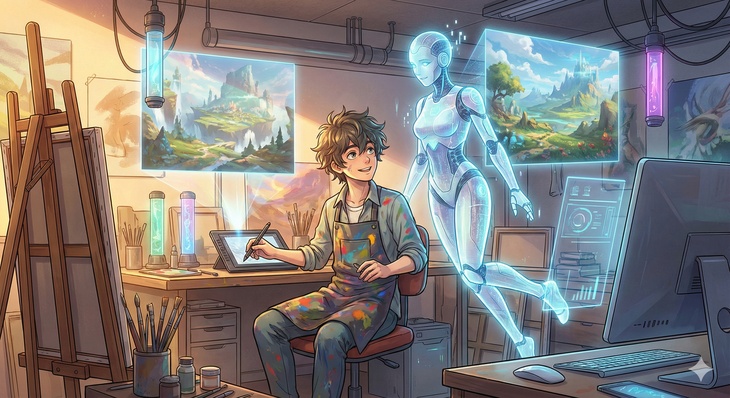
The Rise of Generative AI: Reshaping Creativity
中文翻譯
在過去的幾年裡,世界見證了由生成式人工智慧(AI)領導的技術革命。與旨在分析數據和做出預測的傳統 AI 不同,生成式 AI 具有創造全新內容的能力,包括文字、圖像和音樂。這一突破由複雜的神經網絡驅動,這些網絡已經在海量的人類生成數據上進行了訓練。雖然這些工具最初被視為僅僅是新奇事物,但現在它們正成為從廣告到軟體開發等各個行業中不可或缺的一部分。生成式 AI 對創意部門的影響尤為深遠。平面設計師現在可以使用 AI 生成初步草圖,使他們能夠更多地專注於完善概念,而不是執行重複性任務。同樣地,作家使用 AI 助手通過生成想法或結構大綱來克服「寫作障礙」。然而,這種便利也帶來了重大的倫理疑慮。許多藝術家擔心版權侵權,因為 AI 模型通常在未經明確許可的情況下使用他們的作品進行訓練。人們也越來越擔心 AI 最終可能會完全取代人類創作者。
儘管存在這些爭議,專家們相信未來在於人機協作。專業人士被鼓勵不要將 AI 視為競爭對手,而是將其視為增強人類潛力的強大工具。通過自動化日常流程,AI 讓人類有更多時間進行高層次的策略思考和情感表達——這些品質是機器仍然難以複製的。隨著我們邁向 2026 年,關鍵將是建立明確的法規,在保護知識產權的同時促進技術創新。
🔑 重點單字 (Vocabulary)
- integral adj.. 不可或缺的;整體的
- copyright n. / v.. 版權;著作權
- collaboration n.. 合作;協作
- replicate v.. 複製;重複
- innovation n.. 創新;革新
- Generative adj.. 生成的;有生產力的
- profound adj.. 深遠的;深刻的
- refining v.. 完善;精煉
- infringement n.. 侵權;違反
- explicit adj.. 明確的;詳盡的
掌握一種語言等於擁有一個新世界
 語言健身房 https://www.langym.com 提供
語言健身房 https://www.langym.com 提供
