
Since its successful deployment, the James Webb Space Telescope (JWST) has fundamentally altered our understanding of the universe's infancy. Unlike its predecessor, the Hubble Space Telescope, which primarily observes visible light, the JWST is engineered to detect infrared radiation. This capability allows it to peer through dense clouds of cosmic dust that shroud the birth of stars and planetary systems, effectively acting as a high-definition time machine that looks back over 13.5 billion years to the "cosmic dawn".
The primary scientific objective of the JWST is to observe the first galaxies formed after the Big Bang. Recent data transmitted back to Earth have revealed galaxies that are far more massive and mature than theoretical models previously predicted. This discrepancy has forced astrophysicists to re-evaluate established timelines regarding how quickly structure emerged in the early universe. Furthermore, the telescope's sophisticated spectrographs have enabled the detailed chemical characterization of exoplanet atmospheres, searching for signs of water, methane, and other potential biosignatures.
However, the operation of such a complex instrument at the second Lagrange point (L2) presents immense logistical challenges. Maintaining the telescope's mid-infrared instrument at temperatures near absolute zero is crucial for its sensitivity. Despite these hurdles, the JWST continues to provide a wealth of data that challenges our most basic cosmological assumptions. By capturing the faint, stretched light from the dawn of time, the telescope is not only expanding the boundaries of human knowledge but also fostering a sense of profound humility as we contemplate our place in the vast, expanding tapestry of the cosmos.
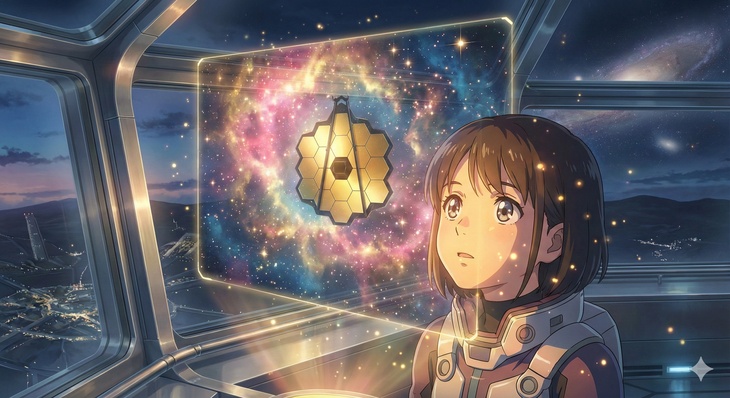
Peering into the Cosmic Dawn: The Legacy of the James Webb Space Telescope
中文翻譯
自成功部署以來,詹姆斯·韋伯太空望遠鏡 (JWST) 從根本上改變了我們對宇宙初期的認知。與主要觀察可見光的前輩哈伯太空望遠鏡不同,JWST 的設計旨在探測紅外線輻射。這種能力使其能夠穿透遮蔽恆星和行星系統誕生的濃厚宇宙塵埃雲,有效地扮演了一台高解析度時光機,回溯超過 135 億年,直達「宇宙黎明」。JWST 的主要科學目標是觀察大霹靂後形成的第一批星系。最近傳回地球的數據顯示,這些星系的質量和成熟度遠高於先前理論模型的預測。這一差異迫使天文物理學家重新評估關於早期宇宙結構形成速度的既定時間表。此外,望遠鏡先進的光譜儀使我們能夠對系外行星的大氣層進行詳細的化學特徵分析,尋找水、甲烷和其他潛在的生物特徵。
然而,在第二拉格朗日點 (L2) 運行如此複雜的儀器面臨著巨大的物流挑戰。將望遠鏡的中紅外儀器維持在接近絕對零度的溫度,對於其靈敏度至關重要。儘管存在這些障礙,JWST 仍持續提供大量數據,挑戰我們最基本的宇宙學假設。透過捕捉來自時間黎明的微弱且被拉伸的光線,這台望遠鏡不僅擴張了人類知識的邊界,也當我們沉思於浩瀚且擴張中的宇宙織面時,培養出一種深切的謙卑感。
🔑 重點單字 (Vocabulary)
- infrared adj./n.. 紅外線的
- shroud v.. 遮蔽;覆蓋
- predecessor n.. 前身;前輩
- massive adj.. 巨大的;厚重的
- re-evaluate v.. 重新評估
- biosignature n.. 生物特徵
- logistical adj.. 物流的;後勤協調的
- absolute zero n.. 絕對零度
- profound adj.. 深切的;深奧的
- tapestry n.. 織錦;複雜的結構
掌握一種語言等於擁有一個新世界
 語言健身房 https://www.langym.com 提供
語言健身房 https://www.langym.com 提供
