
In the modern digital landscape, information is no longer a scarce resource; rather, it is our attention that has become the ultimate commodity. Coined as the "Attention Economy," this socioeconomic theory suggests that because human focus is finite, the various platforms and applications we consume are in a constant, aggressive competition to capture it. While these technological advancements offer unparalleled access to knowledge, cognitive psychologists are increasingly concerned about their long-term impact on our ability to engage in "deep work" and sustained concentration.
The primary mechanism utilized by digital platforms to maintain user engagement is the "intermittent reinforcement" schedule, similar to that of a slot machine. Each notification or "like" triggers a dopamine release, creating a neurological feedback loop that encourages habitual checking. This constant state of fragmentation—switching between tasks and tabs—leads to what researchers call "continuous partial attention." Unlike multi-tasking, which implies efficiency, this state often results in cognitive overload and a diminished capacity for critical thinking and memory retention.
Furthermore, the architectural design of infinite scrolling and autoplay features exploits our biological vulnerabilities, making it difficult for the prefrontal cortex to exercise executive control. The consequence is a noticeable shift in reading patterns; individuals are moving away from linear deep reading toward a "skimming" behavior. To counteract these effects, scholars advocate for "digital minimalism" and the intentional creation of "analog spaces." Reclaiming our focus is not merely a matter of productivity; it is a fundamental step in preserving our cognitive autonomy and mental well-being in an increasingly distracting world. The challenge of the 21st century may not be how we find information, but how we manage to ignore the irrelevant.
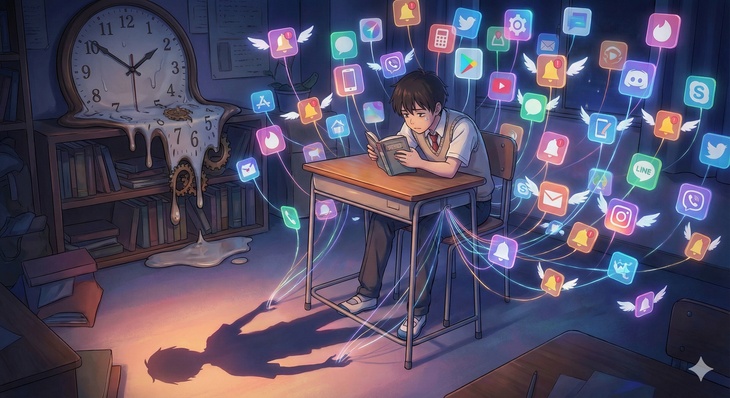
The Scarcity of Focus: Cognition in the Attention Economy
中文翻譯
在現代數位景觀中,資訊不再是稀缺資源;相反地,我們的注意力已成為最終的商品。這套被稱為「注意力經濟」的社會經濟理論認為,由於人類的專注力是有限的,我們使用的各種平台和應用程式正處於一場持續且激進的競爭中,以奪取這份專注力。雖然這些技術進步提供了前所未有的知識獲取管道,但認知心理學家越來越擔心它們對我們進行「深度工作」和持續集中注意力能力的長期影響。數位平台用來維持使用者參與度的主要機制是「間歇性強化」時程表,這與老虎機的機制類似。每一次通知或「點讚」都會觸發多巴胺釋放,創造出一個鼓勵習慣性檢查的神經回饋迴路。這種持續的碎片化狀態——在不同任務和分頁之間切換——導致了研究人員所說的「持續性部分注意力」。這不同於意指效率的多工處理,這種狀態往往導致認知負荷過重,並削弱批判性思考和記憶保留的能力。
此外,無限滾動和自動播放功能的架構設計利用了我們的生物脆弱性,使前額葉皮質難以行使執行控制。其後果是閱讀模式的明顯轉變;個人正從線性的深度閱讀轉向「略讀」行為。為了抵銷這些影響,學者們提倡「數位極簡主義」和刻意創造「類比空間」。奪回我們的專注力不僅僅是生產力問題;它是保護我們在日益分心的世界中擁有認知自主權和心理健康的關鍵步驟。二十一世紀的挑戰可能不在於我們如何找到資訊,而是在於我們如何設法忽略無關緊要的事物。
🔑 重點單字 (Vocabulary)
- commodity n.. 商品;日用品
- unparalleled adj.. 無與倫比的
- intermittent adj.. 間歇的
- fragmentation n.. 碎片化
- diminished adj.. 減少的;削弱的
- retention n.. 保留;保持力
- vulnerability n.. 脆弱性
- counteract v.. 抵銷;對抗
- cognitive adj.. 認知的
- autonomy n.. 自主權
掌握一種語言等於擁有一個新世界
 語言健身房 https://www.langym.com 提供
語言健身房 https://www.langym.com 提供
