In the rapidly evolving landscape of the 21st century, the traditional model of higher education is undergoing a significant transformation. For decades, universities primarily focused on providing degrees to young adults immediately leaving high school. However, with the acceleration of technological advancements and the shifting demands of the global economy, this approach is no longer sufficient. To remain relevant, higher education institutions must embrace the concept of lifelong learning, ensuring that education is not merely a destination but a continuous journey.
The driving force behind this shift is the decreasing "shelf life" of professional skills. Knowledge that is cutting-edge today may become obsolete within five years. Consequently, professionals in various fields find it imperative to return to education to update their expertise. Universities are responding by creating flexible learning pathways. Instead of committing to multi-year degree programs, learners can now access "micro-credentials" or short-term certifications. These programs allow individuals to acquire specific skills such as data analysis or digital marketing without disrupting their careers.
Furthermore, integrating technology into the curriculum has made education more accessible than ever before. Online platforms and hybrid classrooms enable prospective students to balance their studies with work and family responsibilities. This adaptability is crucial for fostering a culture of continuous improvement. It empowers workers to "reskill" for new roles or "upskill" to advance in their current positions, thereby enhancing their employability and economic stability.
However, challenges remain. Universities must ensure that these short-term courses maintain the same rigorous academic standards as traditional degrees. Additionally, there needs to be a stronger collaboration between academia and industry. By working closely with corporations, universities can design curricula that directly address real-world problems and workforce gaps.
In conclusion, the future of higher education lies in its ability to serve learners of all ages. By shifting focus from a one-time educational experience to a model of sustained engagement, universities can become hubs of innovation and personal growth. In this dynamic era, the pursuit of knowledge must be a lifelong endeavor, supported by institutions that value agility and excellence.
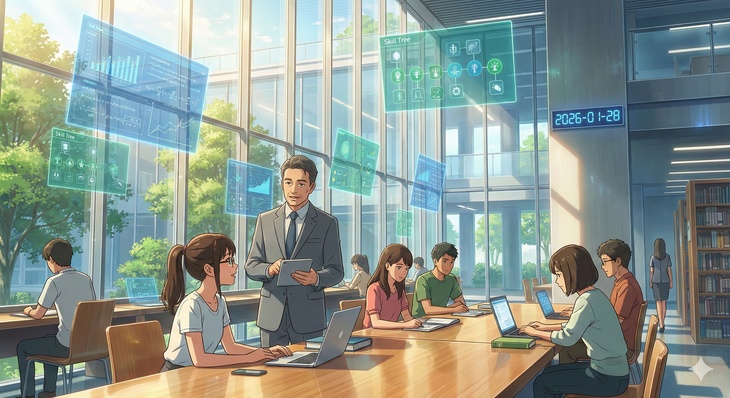
Enhancing Lifelong Learning in Higher Education
中文翻譯
在 21 世紀快速演變的環境中,高等教育的傳統模式正在經歷重大轉變。幾十年來,大學主要專注於為剛離開高中的年輕人提供學位。然而,隨著科技進步的加速和全球經濟需求的轉變,這種方法已不再足夠。為了保持相關性,高等教育機構必須擁抱終身學習的概念,確保教育不僅僅是一個目的地,而是一段持續的旅程。推動這一轉變的驅動力是專業技能「保質期」的縮短。今天最尖端的知識可能在五年內就會變得過時。因此,各個領域的專業人士發現,重返校園更新專業知識是當務之急。大學正在透過創造靈活的學習途徑來應對。學習者現在不需要投入多年的學位課程,而是可以獲得「微證書」或短期認證。這些課程允許個人獲得特定技能 如數據分析或數位行銷 而不會中斷他們的職業生涯。
此外,將科技融入課程使得教育比以往任何時候都更易獲得。線上平台和混合教室使潛在的學生能夠在學習與工作和家庭責任之間取得平衡。這種適應性對於培養持續改進的文化至關重要。它使工人們能夠為新角色「重新技能化」或為在當前職位上晉升而「提升技能」,從而增強他們的就業能力和經濟穩定性。
然而,挑戰依然存在。大學必須確保這些短期課程維持與傳統學位相同的嚴格學術標準。此外,學術界與產業界之間需要加強合作。透過與企業密切合作,大學可以設計出直接解決現實世界問題和勞動力缺口的課程。
總之,高等教育的未來在於其服務各年齡層學習者的能力。透過將焦點從一次性的教育體驗轉移到持續參與的模式,大學可以成為創新和個人成長的中心。在這個充滿活力的時代,對知識的追求必須是一項終身的努力,並由重視敏捷性和卓越的機構來支持。
🔑 重點單字 (Vocabulary)
- obsolete adj.. 過時的;被淘汰的
- imperative adj.. 極重要的;必要的
- curriculum n.. 課程;課程體系
- prospective adj.. 潛在的;預期的
- adaptability n.. 適應能力
- rigorous adj.. 嚴格的;嚴謹的
- institution n.. 機構;制度
- expertise n.. 專業知識;專門技術
- collaboration n.. 合作;協作
- certification n.. 認證;證書
- endeavor n.. 努力;嘗試
- excellence n.. 卓越;優秀
掌握一種語言等於擁有一個新世界
 語言健身房 https://www.langym.com 提供
語言健身房 https://www.langym.com 提供
