
The relentless pursuit of perpetual economic growth, often held up as the sine qua non of a healthy global economy, is increasingly confronting the stark realities of planetary limits. For decades, the mantra of maximizing Gross Domestic Product (GDP) has been the lodestar guiding fiscal policy and corporate strategy. This prevailing paradigm, however, is being subjected to rigorous scrutiny by a growing contingent of ecological economists and systems thinkers who contend that infinite expansion on a finite planet is a logical and existential fallacy.
The core of the issue lies in the discrepancy between economic models—which often treat natural resources as externalities—and the irrefutable thermodynamic laws governing energy and matter. Proponents of degrowth argue that a shift in societal objectives is not merely advisable but imperative. Instead of fixating on quantitative increases in production, they advocate for a focus on qualitative improvements, such as enhancing well-being, fostering equity, and building resilience.
Critics of this radical shift often raise concerns about stagnation and the potential for widespread unemployment. The transition would undoubtedly necessitate a fundamental recalibration of our financial and industrial architectures. However, proponents offer compelling counterarguments, suggesting that a planned, equitable contraction of environmentally destructive industries could free up labor and capital to invest in regenerative and social services—from sustainable agriculture to robust public healthcare. The debate is no longer whether growth is slowing, but whether society can successfully pivot from a mindset of extractive consumption to one of sustainable stewardship. This philosophical and practical dichotomy marks one of the most significant challenges of the 21st century.
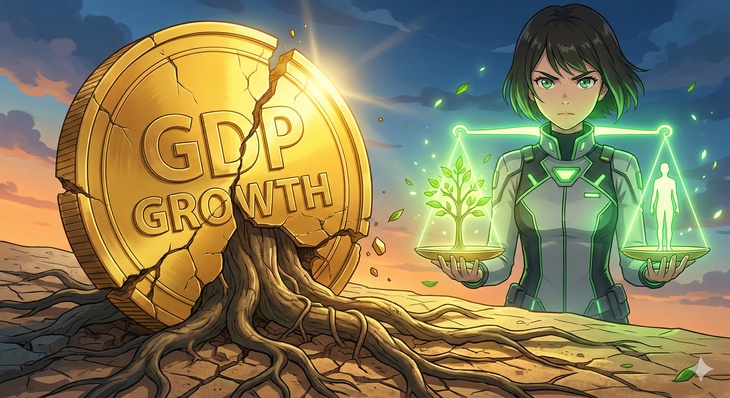
The Paradox of Perpetual Growth
中文翻譯
對永恆經濟增長的持續追求,通常被視為全球健康經濟的必要條件,但它正日益與行星限制的嚴峻現實相衝突。數十年來,將國內生產總值 (GDP) 最大化的口號一直是指導財政政策和企業戰略的指路明燈。然而,這種主流範式正受到越來越多生態經濟學家和系統思想家的嚴格審查,他們認為在一個有限的星球上無限擴張是一個邏輯上和生存上的謬誤。問題的核心在於經濟模型(通常將自然資源視為外部性)與支配能量和物質的不容辯駁的熱力學定律之間的差異。去增長的支持者認為,社會目標的轉變不僅是可取的,而且是絕對必要的。他們主張,與其糾結於產量的量化增長,不如專注於品質的改善,例如提高福祉、促進公平和建立韌性。
這種激進轉變的批評者通常會對停滯和潛在的大規模失業表示擔憂。這種轉變無疑需要對我們的金融和工業架構進行根本性的重新校準。然而,支持者提供了引人注目的反駁,他們認為有計劃、公平地收縮對環境具有破壞性的產業,可以釋放勞動力和資本,用於投資再生和社會服務——從永續農業到強大的公共醫療保健。爭論不再是增長是否正在放緩,而是社會能否成功地從汲取式消費的心態轉變為永續管理的心態。這種哲學上和實踐上的二分法標誌著二十一世紀最重大的挑戰之一。
🔑 重點單字 (Vocabulary)
- perpetual adj.. 永恆的;持續不斷的
- sine qua non n.. 絕對必要條件;不可或缺的要素
- stark adj.. 嚴峻的;赤裸裸的;完全的
- mantra n.. 咒語;口號;不斷重複的信念
- lodestar n.. 指路明燈;指導原則
- paradigm n.. 典範;範式;模型
- fallacy n.. 謬論;謬誤
- discrepancy n.. 差異;不一致
- irrefutable adj.. 不容辯駁的;無法否認的
- degrowth n.. (經濟)去增長;減速增長
- imperative adj.. 絕對必要的;命令式的
- stagnation n.. 停滯;不景氣
- recalibration n.. 重新校準;重新調整
- pivot v.. 轉變;以...為中心旋轉
- stewardship n.. 管理;照管責任
- dichotomy n.. 二分法;對立
掌握一種語言等於擁有一個新世界
 語言健身房 https://www.langym.com 提供
語言健身房 https://www.langym.com 提供
